
Key takeaways
- The Keto Project is a keto movie about one experiment.
- Burger King won a blind taste test among the fast-food patties.
The Keto Project is a keto movie you can rent or buy on Amazon Prime Video. In it a fit doctor, Dr. Mike Brandon, eats 20 plain Burger King patties a day for 30 days with water only, while we test his blood, his fitness and his heart rate variability. This page lays out what the experiment was built to test and how it was set up, and it leaves the ending for the film.
What is the keto movie The Keto Project actually about?
The Keto Project is a keto movie about one experiment. A fit doctor ate 600 burgers in 30 days on camera while we measured what happened to his body. I made it, and the experiment holds the whole film together. You can rent or buy it on Prime Video.
The idea came from Super Size Me, with one big change. I took out the sugar (bun, condiments, soda) and the vegetable oils (fries) and kept only the meat and water. That left a question the usual debate never isolates. If you strip a fast-food meal down to a high-fat, low-carb plate, is it healthy food, or is meat quality the real problem?
Here is the real problem with most diet arguments. Everybody has an opinion and nobody has a baseline. I wanted to quantify literally everything, because if you aren’t testing, you’re guessing. If you want to compare the setup with the film that inspired it, read Keto Project vs Super Size Me.
Why did the experiment use Burger King patties?
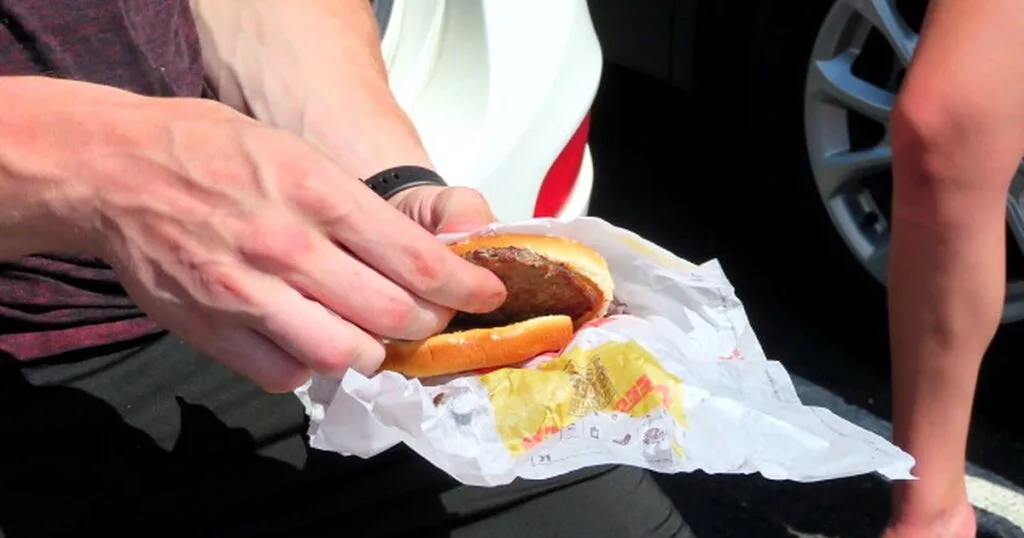
Burger King won a blind taste test among the fast-food patties. A free-range, grass-fed patty beat all three overall. The film shows the test: plain patties from McDonald’s, Wendy’s and Burger King, the only three chains within five miles of us, set against one grass-fed patty.
We ran it double-blind. My daughter Athena plated the samples. My wife Chantea put them down in random order. The tasters wore blindfolds, and I was watching without knowing which sample was which. That was a humbling place for a man who likes being in control of his own experiment.
So the grass-fed patty won, and Dr. Mike ate the runner-up anyway, because the question was about fast food. The full scoring is in Best Fast Food Burger: What a Blind Patty Test Really Found. And for the record, this was never an attack on any restaurant. It was a question about fast food, and somebody’s patty had to win.
What did Dr. Mike eat every day for 30 days?
He ate 20 plain Burger King patties a day for 30 days, with no bun, no condiments and nothing to drink but water. That is the entire protocol. I’ve written longer grocery lists. The film shows it, down to the drive-through order of 140 patties a week, which is not a sentence I ever expected to say to a teenager on a headset.
The person eating was Dr. Michael Brandon. I planned to be the subject myself. Dr. Mike insisted on taking the burgers, and I documented it. I am still not sure whether that was friendship or a dare.
Eat the same meal 20 times a day and you’re testing more than macros. You’re testing appetite, digestion and mood, every single day. Dr. Mike’s journal shows how that went. On Day 5 he wrote about his first dizzy spell on standing. On Day 12 he had lost interest in eating and was setting alarms to remind himself to eat. On Day 18 a dizzy attack hit him in front of a client, and he had to lean back on a bike to stay up.
How was his fitness tested during the burger month?
His fitness was tested three times: at baseline, on Day 14 and on Day 29. Same battery every round, because comparing a good day to a bad day with different tests is how you fool yourself, and I’ve fooled myself plenty.
- ARX strength: horizontal press, lat pulldown and squat
- CAROL bike sprints
- Repeated 40 m and 60 m dashes
- Standing long jump and high jump
- A 1-mile run
The film shows that Day 14 already went the wrong way. As the book records it, his best long jump was an inch shorter than his worst at baseline, and his mile was about 20 seconds slower. Dr. Mike wrote on Day 29 that the last test was “freaking miserable.” What his body did between those two dates is in the film.
Was that just the burgers? Maybe not. Short-term keto can blunt sprint-type effort: a randomized crossover trial in trained women and men found anaerobic performance fell, though that diet lasted only days. Burgers alone are not that diet, and I’d be kidding you if I pretended one study settles our one man. Treat the comparison with care.
Why did you pay for the lab testing yourself?
The lab we used refused to appear in the film, so I paid for the testing myself. That is not hyperbole. It is the price of having skin in the game.
The panels covered hormones, cardiometabolic markers, liver, thyroid, kidneys and inflammation. They were drawn before the burger month, after it, after a reset month and after a month of grass-finished beef. The film shows the baseline draw. The results after the burgers are the reason the film exists, so they stay there. The direction of travel is covered without the ending in What Happened to Dr. Mike’s Blood.
We also tried to test the meat itself. According to the book, every lab either refused or quoted a minimum of $12k. So the patties were never lab-tested. Sit with that for a moment. The food went into a man every day, and nobody would tell us what was in it at a price we could pay.
Is ketosis real, and is that what the film measured?
Yes, ketosis is real, and you can measure it. So we did, with blood ketones, because “I feel like I’m in ketosis” is not data. Trust me, I’ve said it. On camera I explain why I use a minimum of 0.5 millimoles per liter in the blood for “in ketosis” (see the film).
Here’s the part people skip: your body can adapt to it. In a 1983 metabolic-ward study of nine lean men, four weeks of ketosis without calorie restriction caused no disturbance of liver or kidney function. That study was small and short, and it was not a burger diet. The first weeks can be rough, though. Forum reports of “keto flu” describe headache, nausea and dizziness, but those are self-reports with no diagnosis.
Here is the test the film sets up. Were Dr. Mike’s symptoms an adaptation phase, or a signal about what he was eating? The film suggests the answer depends on the food more than the macros. After the burgers came a keto-pescatarian reset month in which he recovered. On a later month of grass-finished beef he declined again, though less. The book concludes he does best on vegetation with some fish. Individual results vary.
Frequently asked questions
Is there a book that goes with the keto movie?
Yes, and I’d read it first. 600 Burgers in 30 Days is the official book of The Keto Project and works as its prequel. Dr. Mike’s day-by-day journal is in there, warts and all, along with the testing setup and the expert interviews. Paperback, Kindle or Audible on Amazon. It takes you right up to the final labs and stops. That part belongs to the film.
Which experts appear in The Keto Project?
The film includes Dr. Dom D’Agostino, a researcher on ketogenic nutrition, Dr. Shawn Baker, an orthopedic surgeon and carnivore-diet author, strength and conditioning coach Ron McKeefery, and IFBB Pro Jason Arntz. I put them in the same film knowing some of them disagree with each other. That was on purpose. If everyone on screen agrees, you’re watching an advert, not an experiment.
What keto snacks can I bring to the movies?
Skip the concession popcorn. Bring something you’ve actually read the label on. Plain cheese, nuts or jerky without added sugar will do the job. Not glamorous. Neither was 600 burgers. Trust the back of the bag, not the front. Our post on seed oil free snacks shows how to check a label without paying extra for marketing claims. And bring water. Dr. Mike drank nothing else for 30 days, so you can manage two hours.
Does low-carb beat low-fat for weight loss?
Not on average, according to one large trial. The DIETFITS randomized trial found that healthy low-fat and healthy low-carb diets produced similar 12-month weight loss, with big differences between individuals. That’s exactly why we tested one body thoroughly instead of promising the same result for everyone. Your average isn’t you. If you aren’t testing, you’re guessing.
The Bottom Line
The burger month was never really about burgers. It tested whether a high-fat, low-carb plate stays healthy when the food behind it is cheap, processed and untested. The film shows the setup, the symptoms and every test point. It does not let you skip to the last page, and neither will I. Large trials such as DIETFITS describe averages. This film follows one man through all 30 days.
So here is the challenge. You have a theory about how you should eat. Do you have a baseline? Watch The Keto Project on Prime Video to see how Dr. Mike’s month ends, and if you want the build-up first, get the prequel, 600 Burgers in 30 Days. Our where-to-watch page has the details.
Sources
- Consumer Reports of "Keto Flu" Associated With the Ketogenic Diet – PubMed
- The human metabolic response to chronic ketosis without caloric restriction – PubMed
- Effect of Low-Fat vs Low-Carbohydrate Diet on 12-Month Weight Loss: The DIETFITS Randomized Clinical Trial – PubMed
- Ketogenic Diets Reduce Athletes' Anaerobic Performance – Technology Networks
This article is for information only and is not medical advice. Individual results vary. Speak to a qualified clinician before changing how you eat.
The whole experiment is in the film. 600 burgers, 30 days, every blood test — and the ending we never post.
Watch The Keto Project on Amazon