Key takeaways
- The MIT team found that a ketogenic diet pushed tumours up in one part of the gut and down in another, and that dietary fat, not ketones, drove both effects.
- Because two people can show the same ketone reading on completely different fats.
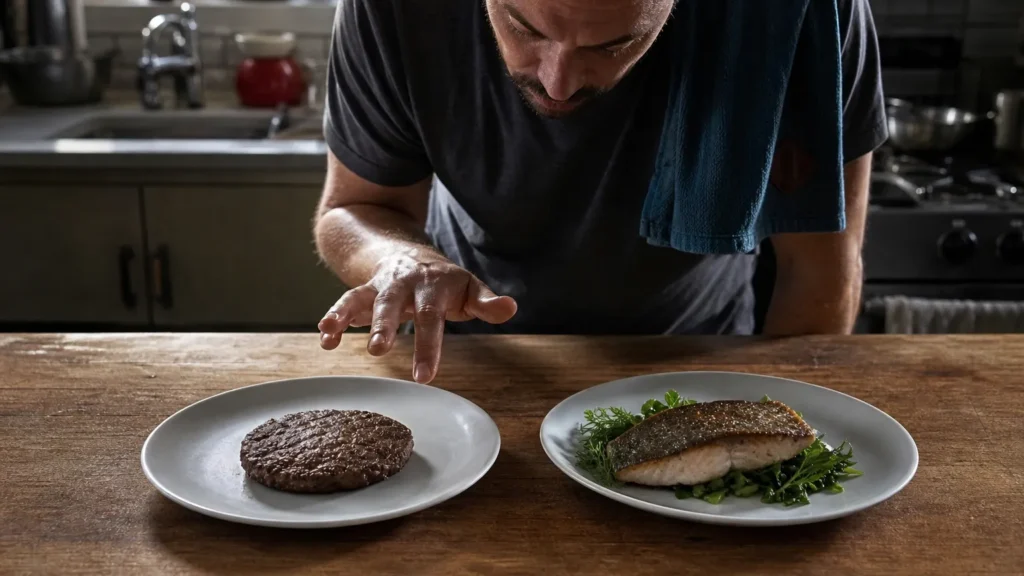
MIT's study found that in cancer-prone mice, a ketogenic diet increased small-intestine tumours and reduced colon tumours, and the effect ran through the dietary fat being burned, not through ketones. That is a mouse result, not proof that keto causes cancer in people. The useful lesson for you is that a ketone reading tells you that you are in ketosis, not what you ate to get there, which is why we tracked every patty Dr. Mike ate for 30 days.
What did MIT's keto lipids not ketones study actually find?
The MIT team found that a ketogenic diet pushed tumours up in one part of the gut and down in another, and that dietary fat, not ketones, drove both effects. That is the whole meaning of keto lipids not ketones. The paper, published in July 2026 in Nature, is titled Ketogenic diet mediates intestinal tumorigenesis through lipids not ketones. The title is the finding.
Here is the test they ran. According to MIT News, the researchers fed mice that were genetically predisposed to intestinal cancer one of three diets: ketogenic, control, or high fat and high calorie. The keto mice developed more small-intestine tumours than the control mice, and they did it without becoming obese. In the colon, the same diet had the opposite effect, as MIT’s EurekAlert release reports.
The evidence says the mechanism is fatty acid oxidation. Technology Networks reports that when the team knocked out PPAR signalling, the crypt cells of keto-fed mice proliferated less. The Nature paper also raised intestinal ketones directly by overexpressing a gene called Hmgcs2, and tumours did not rise. The ketones were bystanders. The fat was the actor.
Does this mean keto causes cancer in humans?
No. This study does not show that keto causes cancer in people, and nobody involved claimed it did. It shows what one diet did in mice engineered to grow intestinal tumours.
Let me explain the limits plainly. These mice carry a genetic setup that makes tumours likely, so the study measures how diet speeds or slows a process that is already loaded. A mouse gut is not your gut. A lab chow keto diet is not your plate. As Newsweek noted, the findings were seen in mice genetically susceptible to intestinal cancer. Omer Yilmaz, the senior scientist, told MIT News that researchers must be “very careful in generalizing the effects that these diets can have.”
So why write about it at all? Because the headline travelled and the detail did not. “Keto causes cancer” is a scary sentence. “Fat burning in small-intestine stem cells drove tumours in a mouse model” is a true one. Only the second is worth your attention.
Why is the fat source a bigger question than the ketone number?
Because two people can show the same ketone reading on completely different fats. The meter tells you that you are burning fat. It does not tell you which fat, or how much.
Here is the real problem. Most people judge their keto by one number on a strip or a finger stick. In my experience, that number becomes the scoreboard, and the food becomes an afterthought. You can reach ketosis on wild salmon and olives. You can reach it on fast-food beef. The meter cannot tell the difference.
The MIT result makes that point at the cellular level. If the fat itself is what the cells respond to, then the fat is what you should be watching. I covered what changes when the source of that fat changes in Saturated Fat Keto Inflammation: What the Fat Source Changes, so I will not repeat it here.
What did Dr. Mike actually eat for 30 days?
The film shows a fit doctor, Dr. Mike Brandon, eating 20 plain Burger King patties a day for 30 days, with no bun, no condiments and water only. That is 600 burgers. No sugar, no fries, no seed-oil sides. Just the patty.
We knew exactly what went in because there was only one thing to eat. The film shows Dr. Mike working out his own daily numbers on camera from label data: 160 grams of fat a day, 50 of them saturated. That is his estimate, not a lab assay. We tried to get one. Every lab either refused or quoted a five-figure minimum, so the patties themselves were never lab-tested. Sit with that for a moment. The most-eaten meat in the country, and we could not buy an analysis of it.
The film shows the bloodwork too. The lab we used refused to be part of the film, so I paid for the testing myself. Labs covered hormones, cardiometabolic markers, liver, thyroid, kidneys and inflammatory panels, all on Dr. Mike, none on me.
What happened to Dr. Mike's body during the burger month?
The book records that he got worse in measurable ways long before Day 30. Here are three truths from his month.
- His HRV. It was cut in half within a week, and by Day 19 it was only a little over halfway back to baseline. I wrote up that week in Keto HRV Crash: What One Week of Burgers Did to a Doctor.
- His appetite. On Day 12 Dr. Mike wrote that he had lost interest in eating and was setting alarms to remind himself to eat. On Day 13 he dropped to one knee in a dizzy spell and suspected electrolyte and micronutrient deficiencies.
- His fitness. On Day 29 his ARX numbers were record lows for him, and his mile was his worst “since maybe middle school.”
The film suggests, and this is our interpretation, that being in ketosis was never the whole story. He was burning fat the entire month. What mattered was what that fat was, and what came with it. What the final blood panel showed is in the film, and I am not giving it away here.
Why did The Keto Project track food and not just ketones?
Because if you aren’t testing, you’re guessing, and a ketone reading alone is a guess about everything except ketosis. We wanted to quantify literally everything: the food, the labs, the brain scans, the HRV, the fitness tests.
Then we changed one variable. After the burger month came a keto-pescatarian reset month, and Dr. Mike recovered. On a later month of grass-finished beef he declined again, though less. Same man. Still low carb through all of it. Different fats, different results. The book concludes he does best on vegetation with some fish. That is n=1, and individual results vary. It is also exactly the question the MIT paper asks in mice: not “are you in ketosis?” but “what are you burning?”
In my experience the people who do well on keto are the ones who stop checking their ketones like a lottery ticket and start asking what is actually on the plate. The full story of the 30 days, and the months after them, is in the book, 600 Burgers in 30 Days.
Frequently asked questions
Do exogenous ketone drinks change the lipids question?
No, they don’t take the fat out of the picture, because ketone drinks raise ketones without telling you anything about your diet’s fat. The evidence says ketone salts raised blood beta-hydroxybutyrate only modestly and came with a large sodium load, according to a controlled study on PubMed. In the MIT mice, raising ketones on their own did not drive tumours.
Who led the MIT keto tumour study?
MIT postdoctoral researchers Jessica Shay and Fangtao Chi were the lead authors, with Omer Yilmaz as senior scientist. Yilmaz directs the MIT Stem Cell Initiative and is part of the Koch Institute for Integrative Cancer Research.
Did the keto diet protect the colon in the MIT mice?
Yes. In the same mice, the ketogenic diet reduced colon tumours while it increased small-intestine tumours. Technology Networks reports that the colon benefit was also traced to dietary fat rather than ketones. That split is why the researchers warn that one diet can help one tissue and harm a neighbouring one.
Was Dr. Mike's burger month a ketogenic diet?
It was a zero-carb, patty-only month: plain Burger King beef and water, with the bun, condiments and fries removed on purpose. The idea, inspired by Super Size Me, was to strip out the sugar and the vegetable oils and leave only the meat. Whether he stayed in ketosis, and what the Day 30 numbers showed, is revealed in the film.
Should I stop keto because of the MIT study?
A mouse study alone is not a reason to start or stop any diet, and that decision belongs with your own doctor and your own bloodwork. What the study does give you is a better question to ask: which fats you are eating, not just whether you are in ketosis. Testing, not headlines, is how you find out what works for your body.
The Bottom Line
The MIT mice did not prove keto causes cancer. They showed something more useful: the fat you burn to get into ketosis may matter more than the ketones themselves. A ketone meter answers one question. Your plate answers the rest.
We put one fit doctor on one fat source for 30 days and measured what it did to him. How his story ends, and what the blood showed when the burgers stopped, is what the film is for. What will you do with that knowledge? Watch The Keto Project on Prime Video, rent or buy, and see the numbers for yourself.
Sources
- Ketogenic diet mediates intestinal tumorigenesis through lipids not ketones (Nature)
- Ketogenic diets may increase cancer risk in the small intestine (MIT News)
- Ketogenic diets may increase cancer risk in the small intestine (EurekAlert)
- Fats, Not Ketones, Shape How Keto Diets Influence Cancer Risk (Technology Networks)
- Popular Diet Linked to Increased Risk of One Cancer, Study Finds (Newsweek)
This article is for information only and is not medical advice. Individual results vary. Speak to a qualified clinician before changing how you eat.
The whole experiment is in the film. 600 burgers, 30 days, every blood test — and the ending we never post.
Watch The Keto Project on Amazon